Super Mario Bros. 3 Remains One of the Greatest Platformers Ever Made

Nintendo produced arcade machines and handheld games before entering the home-console market, but the Nintendo Entertainment System turned the company into a household name. Originally released in Japan as the Famicom, the eight-bit system introduced players to several important Nintendo franchises and helped revolutionize platform games.
Nintendo’s 1981 arcade hit Donkey Kong was one of the earliest platformers to make jumping a central part of its gameplay. Only seven years later, Nintendo released a game that nearly perfected the genre: Super Mario Bros. 3.
More than three decades after its original Japanese release, Super Mario Bros. 3 remains a remarkably creative, responsive and entertaining platformer.
Super Mario Bros. Established an Icon
The original Super Mario Bros. deserves recognition as one of the most important video games ever created. Released for the NES in 1985, it helped popularize Nintendo’s home console and introduced millions of players to the Mushroom Kingdom.
Mario had previously appeared as Jumpman in Donkey Kong. He was later joined by Luigi in the 1983 arcade game Mario Bros. However, it was Super Mario Bros. that transformed Mario into gaming’s most recognizable character.
Its straightforward controls made it easy for new players to understand, while its hidden areas, shortcuts and increasingly challenging levels rewarded practice and exploration. The game created the basic formula Nintendo would continue refining for decades.
The franchise took an unusual turn with Super Mario Bros. 2. Japanese players received a much more difficult continuation of the original game, which was eventually released in North America as Super Mario Bros.: The Lost Levels.
Western audiences instead received a modified version of another game called Yume Kōjō: Doki Doki Panic. Nintendo replaced its original characters with Mario, Luigi, Princess Toadstool and Toad, creating the North American version of Super Mario Bros. 2.
Although different from the first game, it introduced several characters and gameplay elements that eventually became permanent parts of the Mario universe.
Super Mario Bros. 3 Defined the Series’ Future
The different versions of the franchise came back together with Super Mario Bros. 3, which was first released in Japan in 1988 before arriving in North America in 1990.
The original Super Mario Bros. may have been more influential, but Super Mario Bros. 3 established the structure that would guide many of Mario’s later adventures.
One of its most important additions was the world map. Instead of automatically moving from one level to the next, players could travel across a themed map and select different stages. Some paths offered choices, while secret areas and special items encouraged players to explore.
Each world had its own identity. Mario traveled through grasslands, deserts, oceans, giant-sized environments, icy regions and dangerous fortresses. The constantly changing settings made the adventure feel much larger than the original game.
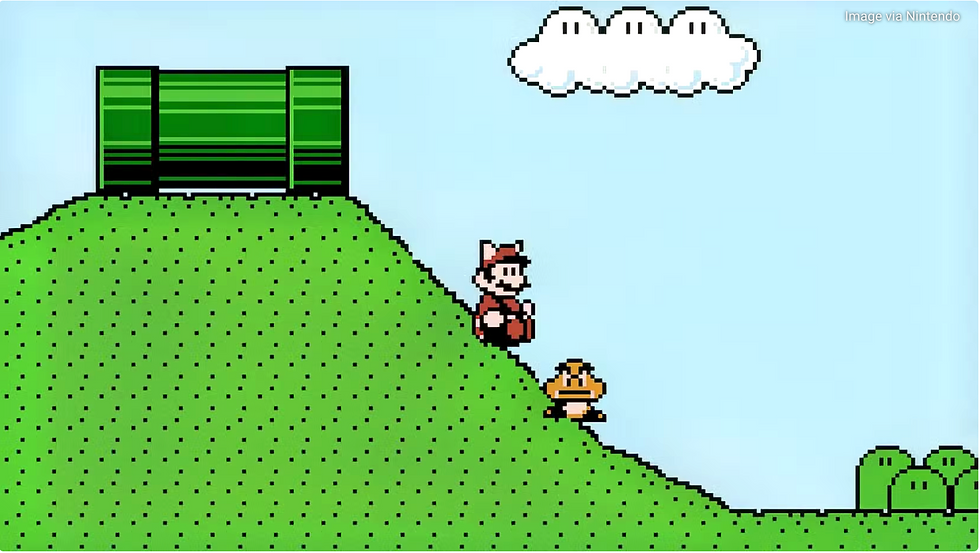
The game also introduced memorable power-ups, including the Super Leaf and Tanooki Suit. These abilities allowed Mario to fly, reach hidden areas and occasionally transform into a statue. Flying fundamentally changed how players explored levels because important secrets could now be hidden above the visible screen.
Other new items included the Frog Suit, which improved Mario’s underwater movement, and the Hammer Suit, which gave him a powerful projectile attack.
These transformations made experimentation part of the experience. Players were no longer simply attempting to reach the end of each stage—they were searching for new ways to move through it.

The Koopalings Gave Every World a Personality
Super Mario Bros. 3 also marked the first appearance of the Koopalings. Each one controlled a different kingdom and served as the boss of that world’s airship.
These colorful characters provided more variety than repeatedly fighting nearly identical versions of Bowser. Their personalities, designs and different attack patterns helped make every world feel distinct.
The game’s level progression also established a rhythm that would continue throughout the franchise. Players moved through traditional stages, fortresses, Toad Houses and special encounters before reaching an airship and challenging a Koopaling.
Bowser remained the ultimate villain, but the Koopalings gave Mario several memorable enemies to face before the final confrontation.
The Mushroom Kingdom Became Bigger and Stranger
The North American version of Super Mario Bros. 2 deserves credit for expanding the series beyond the environments found in the original game. However, Super Mario Bros. 3 created a more recognizable blueprint for what the Mushroom Kingdom would eventually become.
Its worlds were colorful, unpredictable and filled with unusual creatures. Chain Chomps, Boos and Thwomps all made early appearances in the game before becoming recurring parts of the franchise.
The game also presented its adventure as if it were a theatrical production. The opening screen features a rising curtain, platforms appear to hang from the ceiling, and some background objects look like stage decorations. At the end, the curtain falls again.
That presentation has inspired years of debate over whether the events of the game are supposed to be an actual adventure or a performance staged by Mario and his friends. Regardless of the answer, it gives the game an additional layer of personality.
The Gameplay Still Feels Excellent
The historical importance of Super Mario Bros. 3 would mean little if the game were no longer enjoyable. Fortunately, its platforming remains remarkably strong.
Mario’s movement is responsive, and his momentum gives every jump a satisfying sense of speed and weight. The levels introduce new ideas quickly without allowing them to become repetitive.
One stage may ask Mario to outrun the sun as it dives toward him. Another may feature giant enemies and enormous blocks. A later level might require him to leap across moving tanks or survive inside an airship filled with cannons.
The game continually finds new ways to challenge the player using the same basic controls.
Its detailed sprites and colorful environments also remain visually appealing. The NES had strict technical limitations, but Nintendo used those limitations creatively. Every enemy is easy to identify, each world has a recognizable appearance, and the animation gives Mario and his enemies plenty of personality.
The difficulty is also demanding without feeling completely unfair. Later worlds require precise timing and patience, but players can use items, alternate routes and secret Warp Whistles to make the adventure more manageable.
One of the Best Platformers of All Time
Among Mario’s traditional two-dimensional adventures, Super Mario Bros. 3 is often compared with Super Mario Worldon the Super Nintendo and Super Mario Bros. Wonder on the Nintendo Switch.
Those games benefit from more powerful hardware and decades of additional design experience, yet Super Mario Bros. 3still belongs in the same conversation.
Many games from the eight-bit era have not aged gracefully. Their controls can feel stiff, their designs may be excessively punishing, and their technical limitations are often difficult to overlook.
Super Mario Bros. 3 avoids most of those problems. Its controls remain responsive, its levels are inventive, and its secrets continue to reward curious players. It can still entertain someone discovering it for the first time nearly four decades after its original release.
Nintendo did not simply create one of the defining games of the NES era. It developed a platforming formula that continues to influence Mario games today.
The original Super Mario Bros. changed the industry, but Super Mario Bros. 3 showed how quickly Nintendo could take a revolutionary idea and transform it into something close to perfection.


Comments